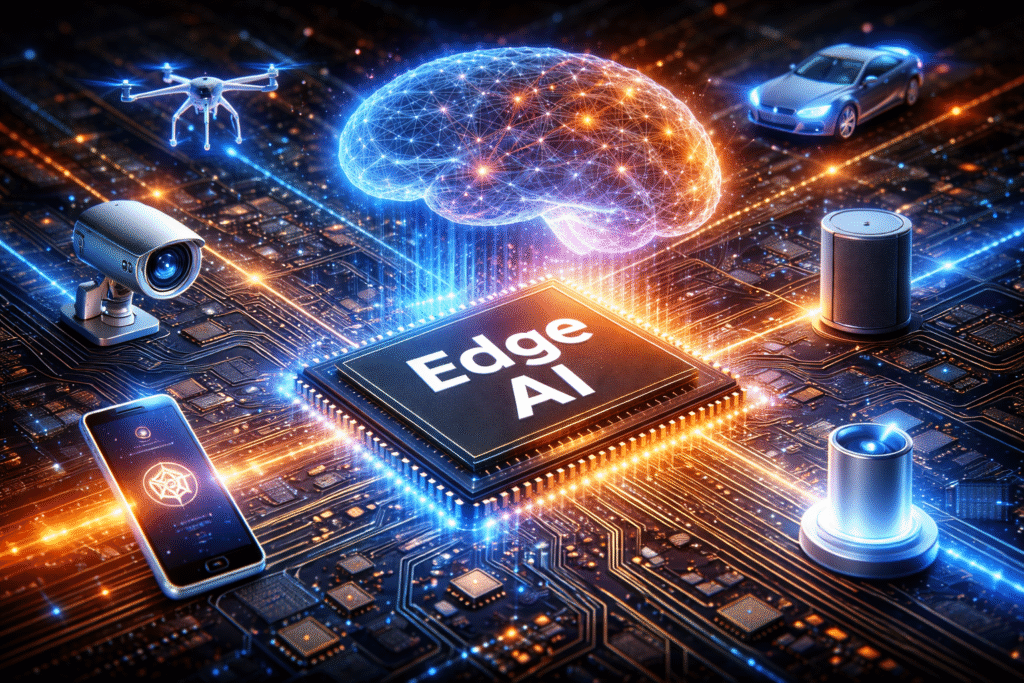
AI can unlock new doors for making sense of data at the edge, but deploying AI on edge hardware is a challenge. Neural networks come with a significant computational and memory cost, which must be balanced against latency and throughput requirements, and integrated with complex I/O and networking.
At EmLogic, we help bridge the gap between data science and embedded systems with tailored, highly-efficient, and open-source solutions. From tiny microcontrollers to custom AI accelerators on FPGA, our team has the expertise to make your Edge AI projects succeed.
Maximize orbital autonomy by deploying radiation-tolerant AI accelerators that process high-bandwidth sensor data in real-time, drastically reducing downlink costs and latency.
Space-Edge AI
Achieve nanosecond-level signal classification and interference mitigation through direct RF-to-FPGA dataflow architectures that bypass traditional processing bottlenecks.
RF/Radar-Edge AI
Eliminate costly downtime with always-on, low-latency, small-footprint neural networks that detect structural and operational failures at the source before they escalate.
Anomaly Detection
Extend mission endurance for automated underwater vehicles by integrating high-efficiency vision and sonar models optimized for the most stringent power and thermal constraints.
Underwater Robotics
Enable real-time surgical guidance and diagnostic assistance by embedding low-latency, small-footprint AI directly into imaging hardware for safer clinical outcomes.
Medical Imaging
Automate biomass monitoring and health assessments in remote maritime environments using robust, low-power vision systems designed for long-term reliability at the edge.
Precision Aquaculture
Co-Design
Deploying off-the-shelf models on commodity hardware is rarely an option for Edge AI. The neural network must be co-designed with hardware capabilities and system-level requirements like latency, throughput and jitter in mind.
Quantization-Aware Training
Quantization is very popular for bringing down inference cost, but impacts quality if not applied carefully. With quantization-aware training (QAT) techniques, we can deliver solutions with good quality while quantizing down to as few as 2 bits.
Tight System Integration
Edge AI typically typically requires real-time processing of sensor data. Round-trips to DDR between sensor and AI introduce additional latency and jitter. Tighter system integration and careful considerations on data movement helps avoid such problems, ensuring that real-time constraints are met.
Custom FPGA Acceleration
With fine-grained arithmetic and memory resources, excellent I/O capabilities and endless customizability, FPGAs are an excellent choice for Edge AI. We can create dedicated accelerators with unrivalled performance, efficiency and easy integration into streaming systems.
Commitment to community and open-source
We support building the Norwegian Edge AI community through the Edge AI Norway Meetup organized in Trondheim and Asker.
We use and contribute to open-source Edge AI to deliver solutions with transparency, longevity and the possibility of customization and bugfixes at every step without being locked in to vendor timelines.